Health
- Home
- Health
Health
Imagine a mother in a remote village going into labour in the middle of the night. The nearest hospital with proper delivery facilities is over an hour away, there is no ambulance nearby, and the only help available is a local traditional birth attendant with no formal medical training. This is not a rare emergency — for millions of women across rural Pakistan, it is simply what childbirth looks like.
The statistics behind this scene are sobering. Pakistan’s maternal mortality ratio remains among the highest in South Asia, with well over a hundred mothers dying for every 100,000 live births — many of these deaths entirely preventable with timely medical care. Access is a huge part of the problem: in rural areas, there is roughly one doctor for every 3,500 people, compared to about one for every 1,000 people in cities, and only around 30% of rural health facilities are equipped to handle emergency complications during childbirth. Basic health services are simply absent in nearly a third of rural areas. For an ordinary family, this means that a health emergency — a difficult delivery, a child’s high fever, a snake bite — can quickly turn into a matter of life and death, simply because help is too far away, too expensive, or arrives too late.
The human cost of this gap goes far beyond the emergency room. When a mother dies during childbirth, her surviving children — especially daughters — are far more likely to be pulled out of school, married early, or pushed into work to help the family survive. Poor health in a community also quietly drains its economic potential: parents who are constantly sick or caring for sick family members cannot work consistently, and children who are malnourished or frequently ill struggle to concentrate and learn in school. Health, in other words, is the foundation everything else in a family’s life is built on — and when that foundation is shaky, everything built on top of it becomes fragile too.
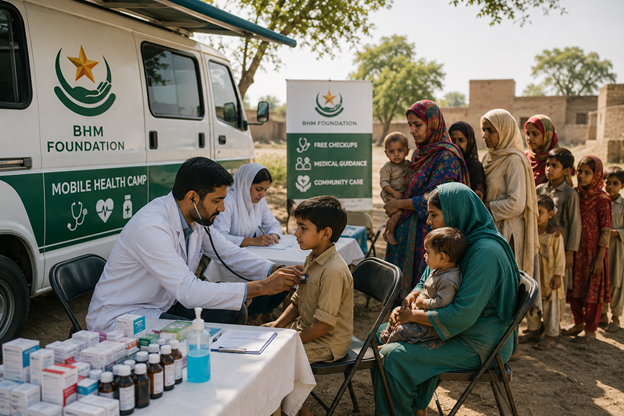
BHM Foundation’s health-focused work is built around bringing care closer to the people who need it most. This includes organizing basic health and medical camps in underserved communities, supporting mothers with maternal health awareness and access to skilled care during pregnancy and childbirth, and helping families understand basic hygiene and preventive health practices that can stop illness before it starts. We also work to connect vulnerable families with existing government and NGO health resources that they may not know how to access or navigate on their own — because sometimes the biggest barrier isn’t a lack of services, but a lack of awareness that they exist.
We focus heavily on maternal and child health because the ripple effects are so significant: a mother who survives childbirth safely, and whose child survives its first fragile years, is a mother who can go on to raise, educate, and provide for her family for decades to come. Every rupee spent on preventive healthcare and awareness saves many more down the line in emergency treatment, lost income, and lost potential.
Real progress in Pakistan’s health system will require sustained government investment, more trained healthcare workers in rural areas, and better transport and emergency infrastructure. But community-level work — the kind BHM Foundation does every day — fills a critical gap right now, for families who cannot afford to wait for systemic change to reach them.
You can be part of closing this gap. Whether through supporting a health camp, contributing toward maternal health kits, or helping fund transport for a pregnant woman in an emergency, your support directly translates into lives saved. Health is not a luxury — it is the starting point for everything else a person hopes to achieve in life, and together, we can make sure fewer families in Pakistan have to face a health emergency alone.
Donate
Every contribution helps us reach more families in need. Your generosity fuels our impact.