
Environment
- Home
- Environment
Environment
Think of a farming family in interior Sindh, whose fields have flooded twice in the past few years, whose only well now runs half-dry for months at a time, and whose children cough constantly from the dust and smoke that hangs over their town. This family has done almost nothing to cause climate change — yet they are living through its consequences every single day.
Pakistan contributes less than 1% of global greenhouse gas emissions, but it consistently ranks among the countries most vulnerable to climate change in the world. The evidence is everywhere:
Catastrophic floods that have displaced millions of people in recent years, glacial melt in the north that threatens water supplies downstream, and extreme heatwaves in cities like Jacobabad that have pushed temperatures past 50°C. On top of climate change itself, Pakistan is losing its forest cover rapidly — today, forests cover only around 5.6% of the country’s land — which worsens flooding, erosion, and biodiversity loss. Meanwhile, air pollution in cities like Lahore and Karachi regularly reaches hazardous levels, and water scarcity is becoming a daily reality for a growing share of the population as rivers run lower and groundwater is over-extracted.
For families on the ground, these aren’t abstract statistics — they are lost harvests, contaminated drinking water, children with chronic respiratory problems, and homes rebuilt again and again after each flood. Environmental degradation is estimated to cost Pakistan’s economy the equivalent of several percentage points of GDP every year, but the real cost is measured in disrupted lives: farmers who can no longer predict the seasons, mothers boiling water they’re not sure is safe, and communities forced to migrate when their land simply stops supporting them.
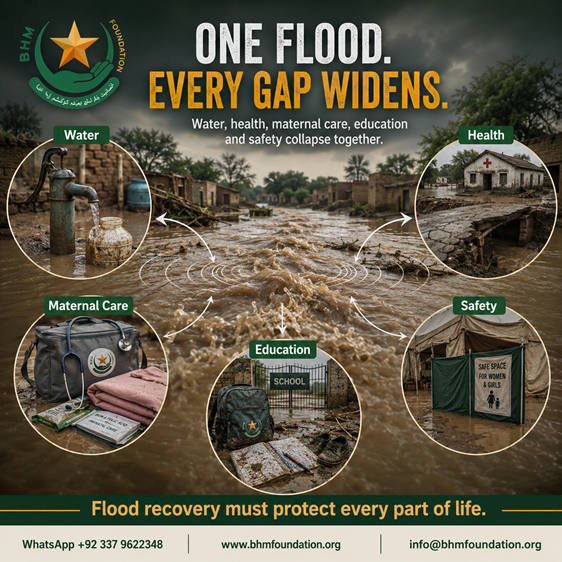
BHM Foundation’s environmental work focuses on the practical, community-level actions that make the biggest difference to daily life. This includes improving access to clean drinking water in communities where existing sources are contaminated or unreliable, organizing tree plantation drives to help restore degraded land and reduce flood risk, and running climate and environmental awareness programs that help communities understand simple changes — like better waste disposal or water conservation — that protect both health and livelihoods. We also support disaster relief efforts for families affected by flooding and other climate-related emergencies, helping them recover and rebuild.
We believe environmental work and human welfare work are really the same thing, seen from two angles. Clean water isn’t just an environmental goal — it’s the difference between a healthy child and one battling waterborne disease. A newly planted forest isn’t just about carbon or biodiversity — it’s flood protection for the village downstream. When we talk about protecting the environment, we are really talking about protecting the people whose lives and livelihoods depend entirely on the land, water, and air around them.
Solving Pakistan’s environmental crisis will require serious national and global action — stronger policy, climate financing, and international cooperation. But local, hands-on work matters enormously too, because it protects specific families and communities right now, while also building the kind of grassroots awareness that eventually drives bigger change.
You can help protect the environment that vulnerable communities in Pakistan depend on — by supporting a clean water project, contributing to a tree plantation drive, or helping fund emergency relief for flood-affected families. Every tree planted and every well restored is a small but real step toward a safer, more resilient future for the people who have contributed the least to this crisis but are paying the highest price for it.
Donate
Every contribution helps us reach more families in need. Your generosity fuels our impact.