Children’s Rights
- Home
- Children’s Rights
Children's Rights
Consider a twelve-year-old boy working long hours at a workshop instead of sitting in a classroom, or a fourteen-year-old girl being prepared for marriage instead of preparing for her school exams. These are not distant or unusual stories — they are the reality for millions of children across Pakistan, children whose right to simply be children has been quietly taken away by poverty, tradition, or circumstance.
An estimated 3.3 million children in Pakistan are trapped in child labour, working in conditions that often harm their health, safety, and development, instead of attending school. Alongside this, child marriage remains widespread: roughly 18% of girls nationally are married before the age of 18, with the figure rising to over 20% in rural areas and even higher in some regions. Girls who marry young are far more likely to drop out of school, face domestic violence, and experience serious health risks from early pregnancy. There has been real progress — for instance, a recent landmark law banned child marriage in Islamabad Capital Territory, setting an important precedent — but for most children across the country, legal protection still hasn’t caught up with the scale of the problem, and enforcement remains weak.
The reasons behind child labour and child marriage are rarely about parents not caring for their children. More often, they are about survival: a family too poor to feed everyone sends a child to work; a family fearing for a daughter’s safety or reputation marries her off young, believing it protects her future.
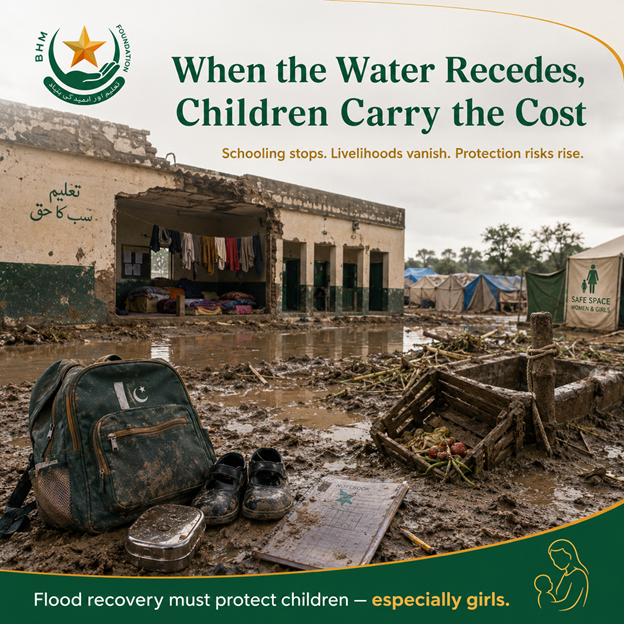
Natural disasters, like floods, often push even more children into these situations, as desperate families lose their income and turn to drastic measures. Whatever the reason, the outcome for the child is the same — a childhood cut short, and a future narrowed before it has really begun.
BHM Foundation’s work on children’s rights is centred on protecting the most vulnerable children and giving their families real alternatives to child labour or early marriage. This includes identifying children at risk in the communities we work in, supporting families with the resources that reduce the pressure to send a child to work, and running awareness campaigns that help parents and community elders understand the long-term harm of child marriage — not as an outside lecture, but as a conversation rooted in the community’s own values around protecting their children. We also work to connect at-risk children with education and rehabilitation support, so that removing a child from labour or an unsafe situation is followed by a real path forward, not just an empty gap.
We believe that protecting children’s rights is not a separate cause from our other work — it is deeply connected to everything we do in education, health, and women’s empowerment. A family that has access to healthcare, a mother who has an income of her own, and a child who is enrolled in school are all far less likely to see child labour or child marriage as their only option. That is why our approach focuses on addressing root causes, not just individual cases.
Lasting change will require stronger enforcement of child protection laws nationwide, more resources for social welfare departments, and sustained economic support for vulnerable families. But every child protected today is a life changed, regardless of how far broader reform still has to go.
You can help protect a child’s right to a real childhood — by supporting our child protection programs, helping fund a family’s alternative to sending their child to work, or simply helping raise awareness in your own community about the harm of child marriage. Every child deserves the chance to be a child first, before anything else is asked of them — and with your support, BHM Foundation can keep making that possible for more children, one family at a time.
Donate
Every contribution helps us reach more families in need. Your generosity fuels our impact.