A seven-year-old boy in a Punjab brick kiln has already put in more overtime this year than his father logged at the same age except the boy isn’t earning a wage of his own. He’s working off a debt his family took out before he could read. A ten-year-old girl in an Islamabad household cooks, cleans, and cares for an infant that isn’t hers, six days a week, for a fraction of what a part-time adult employee would earn if she’s paid at all. A boy of about eight stands at a Lahore traffic signal wiping windshields between red lights, calculating in his head whether today’s total will be enough to avoid a beating at home.
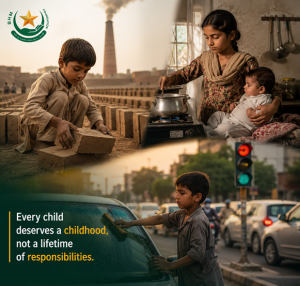
None of these three children know each other either. Like the girl at the hand pump, the mother weighing a 12-village walk to a clinic, and the boy walking 40 minutes to school in BHM Foundation’s earlier campaigns, they stand in for millions of children living a version of the same story.
BHM’s own child welfare messaging puts it simply: “We work for these smiles. Every child deserves a childhood full of laughter, safety, and hope, free from hardship and worry.” It’s a short caption sitting under a photo of a child’s unguarded grin. What it’s quietly arguing against is everything in the paragraph above a childhood spent earning, not laughing.
This piece goes past that caption and into the numbers, the laws, and the organizations working on the exact gap BHM’s child welfare campaign points to: the distance between “every child deserves a childhood” and the millions of Pakistani children who don’t currently get one.
The Scale of the Problem, in Numbers That Don’t Agree With Each Other
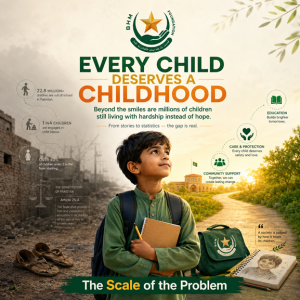
Start with the most recent official estimate. At a media briefing held in Islamabad ahead of World Day Against Child Labour, the International Labour Organization’s Pakistan country office put the number of children aged 5 to 17 currently engaged in labour at 8.6 million, and flagged that roughly 88% of that labour is concentrated in rural areas. The same briefing noted a closely linked figure: an estimated 25.1 million children aged 5 to 16 are currently out of school, a number that sits inside the same 20-to-26-million range BHM’s education campaign has already highlighted.
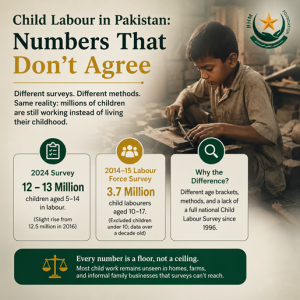
Other credible counts land in different places, and it’s worth being upfront about why. A 2024 survey cited in national reporting put the figure closer to 12 to 13 million children aged 5 to 14 in labour, a slight rise from 12.5 million in 2016. Older government data, from the 2014–15 Labour Force Survey, counted roughly 3.7 million child labourers aged 10 to 17, a number that deliberately excluded children under 10 and is now over a decade old. None of these estimates are lying to each other; they’re measuring different age brackets with different methods in a country that hasn’t run a full national Child Labour Survey since 1996. The honest reading, as with Sahil’s gender-based violence figures in BHM’s women’s safety campaign, is that every one of these numbers is a floor, not a ceiling, in an economy where a huge share of child work happens inside informal family businesses, farms, and homes that no survey reaches.
What isn’t in dispute is the direction of the underlying pressure. Globally, the ILO and UNICEF’s 2025 joint estimate found child labour has nearly halved since 2000, from 246 million children to 138 million, including 54 million in hazardous work. Pakistan is one of the countries still working against that current rather than fully riding it down.
Where the Numbers Live: Bricks, Kitchens, Fields, and Traffic Lights
“Child labour” as a phrase can flatten a genuinely varied picture into one image. In practice, the ILO’s own sector breakdown for Pakistan spans agriculture, brick kilns, domestic work, waste-picking, and a long tail of informal work: hotels, wedding venues, roadside food stalls, small workshops, auto repair, and street vending.
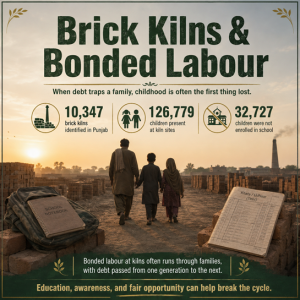
Brick kilns are one of the most visibly documented parts of this picture, largely because bonded labour there tends to run in families rather than individuals. A Punjab Labour Department survey identified 10,347 brick kilns across the province and counted 126,779 children present at those sites, of whom 32,727 were not enrolled in school at all. The children who were enrolled were disproportionately in public rather than private schools, a detail that tracks with how thin the family finances behind kiln work usually are. Bonded labour at kilns works through a debt a family takes out from the kiln owner, then works, generation after generation, without ever fully repaying it, which is precisely why groups like SPARC have run projects specifically aimed at giving bonded brick kiln workers a voice and a path out.
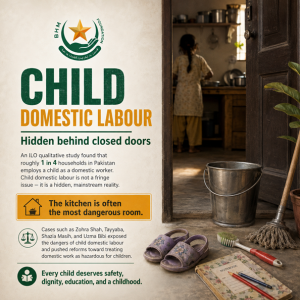
Domestic work is less visible from the outside precisely because it happens behind a front door rather than at a roadside kiln. A qualitative ILO study found that roughly one in every four households in Pakistan employs a child as a domestic worker, a figure that means child domestic labour isn’t a fringe practice confined to a handful of wealthy homes; it’s a mainstream part of how a meaningful share of Pakistani households function day to day.
“The Kitchen Is the Most Dangerous Room”
If BHM’s healthcare content leans on the line “12 villages away” to make distance visceral, the child labour conversation in Pakistan has its own recurring, painful shorthand: a name.
Zohra Shah was eight years old when she was beaten to death by her employers in Rawalpindi in 2020, after the family’s pet parrots escaped while she was cleaning their cage. Tayyaba was ten when she was rescued in 2016 from the Islamabad home of a sitting judge, with burns and bruises documented across her body. Shazia Masih was twelve when she died in a Lahore hospital in 2010 after enduring severe physical and sexual abuse while working as a housemaid. Uzma Bibi was sixteen when her body was found dumped in a Lahore drain in 2019. Each case, on its own, reads as an isolated tragedy that made headlines. Together, they’re a pattern specific enough that Zohra Shah’s death directly pushed Pakistan’s government to reclassify domestic work as hazardous and move toward outlawing child domestic labour altogether.
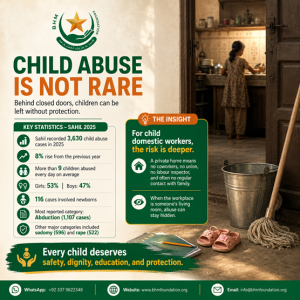
Sahil, the same organization whose gender-based violence data anchored BHM’s “Her Safety Is Her Right” campaign, also tracks abuse specifically against children, and its 2025 figures make clear this isn’t a handful of headline cases. Sahil recorded 3,630 child abuse cases nationwide in 2025, an 8% rise on the year before, meaning more than nine children were abused, on average, every single day. Girls accounted for 53% of victims and boys 47%, with 116 cases involving newborns. Abduction was the most common category at 1,107 cases, followed by 596 cases of sodomy and 522 of rape. As with the GBV figures, the perpetrators were overwhelmingly not strangers; they were the people children were already living or working alongside.
It’s worth being precise about why domestic work in particular carries this level of risk. A child domestic worker is isolated inside a private home, with no coworkers, no union, no labour inspector who will ever see inside that kitchen, and often no contact with her own family for weeks or months at a time. Every protection that exists for a factory or a shop simply doesn’t apply once the workplace is somebody’s living room.
The Law on Paper vs. the Law in the Village
It’s tempting to assume Pakistan simply has no laws against this, and that isn’t accurate. The more instructive problem is how scattered and contradictory the laws actually are.
The federal Employment of Children Act, 1991 set the baseline, restricting children from hazardous sectors and adding protections for workers aged 14 to 18. Since then, provinces have gone their own way, and the results don’t line up. Khyber Pakhtunkhwa’s 2015 Act and Sindh’s 2017 Act both set the minimum working age at 14. Punjab’s Domestic Workers Act, 2019 bans domestic work under 15 but permits “light work” from 15 to 18. Balochistan’s 2021 law goes furthest, setting domestic work’s minimum age at 18 outright. Meanwhile, Article 25A of the Constitution guarantees every child the right to free, compulsory education up to age 16 two full years past the minimum working age most provinces actually allow. A child can be legally out of school and legally at work in the same province, at the same age, under two different laws that were never reconciled with each other.
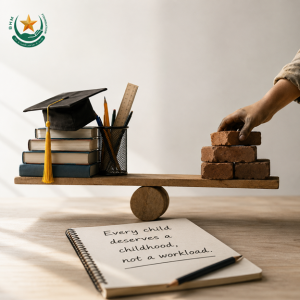
Enforcement tells its own story. A 2023 federal review found Punjab’s labour inspectors conducted over 85,000 child labour inspections that year, including 8,580 specifically at brick kilns, which turned up 771 violations — and resulted in just 34 arrests. That ratio, thousands of documented violations against a few dozen arrests, is less a sign that the law doesn’t exist and more a sign of exactly how thin the enforcement layer is once you get past the legislation itself. It’s the same pattern BHM’s women’s safety piece already surfaced with the Protection Against Harassment of Women at the Workplace Act: a real law, rarely followed through to a real consequence.
Why a Child Works: The Education-Poverty Loop
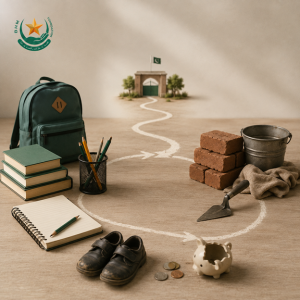
The ILO’s own framing of Pakistan’s numbers is blunt: children out of school are significantly more likely to end up in the workforce, and children already working are significantly less likely to ever complete their education. It isn’t two separate problems running in parallel; it’s one loop, and BHM’s education campaign — built around a child’s 40-minute walk to a classroom — is describing the on-ramp to this same crisis from the other direction.
Poverty is the mechanism that keeps the loop turning. A family living far from a school, without the bus fare or the spare labour to cover a child’s absence from the fields or the house, faces a genuinely difficult calculation, and it isn’t always won by education. Once a child starts working instead of studying, the household’s short-term income improves just enough to make going back to school harder to justify the following year, and a year out of school compounds: a child who falls behind once rarely fully catches back up. Save the Children has already flagged, in the context BHM’s education campaign draws on, that Pakistan’s public education spending sits at roughly 0.8% of GDP, far under the 4–6% international benchmark — meaning even families who do want to keep a child in school are often choosing between a barely-functioning public option and no option at all.
The Organizations Already in This Fight
BHM Foundation isn’t the first to take this on, and the fight it’s joining has a genuinely global lineage.
Inside Pakistan, SPARC — the Society for the Protection of the Rights of the Child — has worked on exactly this issue since 1992, running one of the country’s most consequential campaigns in 1998, when it organized the Global March Against Child Labour across Pakistan. That march, coordinated with the South Asian Coalition on Child Servitude, helped push Pakistan toward ratifying the ILO’s Worst Forms of Child Labour Convention and toward the provincial laws that exist today, patchy as they are. SPARC continues to run projects specifically aimed at giving bonded brick kiln workers a way to document their situation and push back on it.
The South Asian Coalition on Child Servitude was founded by Kailash Satyarthi, the Indian activist who went on to co-receive the 2014 Nobel Peace Prize — shared, in one of the more fitting pairings in the prize’s history, with Malala Yousafzai, the same Pakistani education advocate BHM’s own campaigns already draw a line to. One laureate fought for a child’s right to leave a workplace; the other, for a child’s right to reach a classroom. In Pakistan, those turn out to be the same fight, approached from two directions.
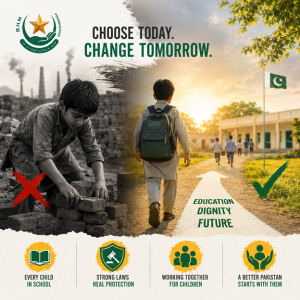
Globally, the ILO and UNICEF jointly track and publish the estimates this piece draws on, and continue to argue that ending child labour requires more than better law enforcement alone — it requires the underlying poverty, informality, and lack of quality schooling to be addressed at the same time, or families will simply keep making the same difficult calculation.
Why This Belongs Alongside BHM’s Other Campaigns
Read on its own, child labour can look like a sixth, separate issue on BHM’s page. It isn’t. It’s what happens when every other gap the foundation already works on goes unaddressed for long enough.
A family with no water source close by loses hours a day to fetching it — hours a child is often the one supplying, which is itself a form of unpaid child labour before a family ever considers sending that same child out to earn. A household with no nearby clinic and a sick parent has fewer working adults and more urgent need for income, which is exactly the pressure that pushes a child toward a brick kiln or a kitchen instead of a classroom. A mother too anemic or malnourished to work, the crisis BHM’s maternal health campaign describes, shifts that same earning pressure onto her older children. And a family under enough economic strain to send a child into a stranger’s home as a domestic worker has, often without realizing it, placed that child directly inside the same “safety at home” gap BHM’s women’s and children’s safety messaging already names.
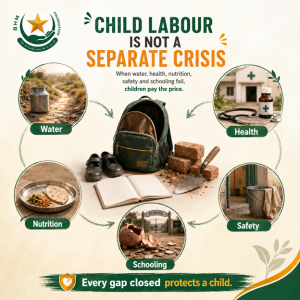
Nothing on BHM’s page is really a standalone issue. Child labour is what the other five problems look like once they’ve been left unresolved long enough to reach a child.
What Support Looks Like
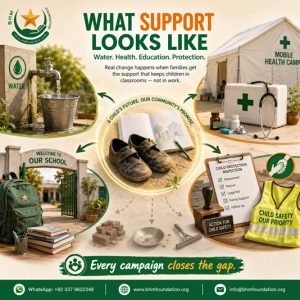
None of the numbers above move on their own. They move when mobile health camps reduce the medical emergencies that push a family toward debt, when a closer school removes the “40-minute” excuse to keep a child home, when a functioning water point gives a girl back the hours she’d otherwise spend fetching water or minding a sibling instead of studying — and when organizations keep showing up to fund and staff the unglamorous work of inspection, legal aid, and rescue that a law alone can’t do.
You can learn more about BHM Foundation’s current work, get involved, or support their campaigns directly at bhmfoundation.org, or reach the team at info@bhmfoundation.org or +92 337 9622348. Their ongoing water, health, education, and child welfare campaigns are also documented in real time across Facebook, Instagram, TikTok, YouTube, and X.
The children in this piece, the boy at the kiln, the girl in someone else’s kitchen, the boy at the traffic light — are the same children BHM’s “We work for these smiles” campaign is already picturing. The distance between that caption and the reality behind it is measured in bricks stacked, dishes washed, and windshields wiped instead of years spent in a classroom. Closing it, campaign by campaign, is the same project BHM has been running all along.